front;
wings detachable.INSTRUMENTATION Basses--6 eight-foot
Stopped Pipes; 6 eight-foot Open
Pipes; 6 Wood Trombones.
NOTE: Contrary
to factory specifications shown
above, the Style 165 organ had 44
loud violin pipes and 44 soft
violin pipes in the melody. Each
of those ranks was a double rank
of pipes, two pipes sounding in
the loud violin rank for each note
and two pipes sounding in the soft
violin rank for each note. Thus
the total number of pipes is 256.
WURLITZER STYLE
166 BAND ORGAN
Style No.
166--Duplex Orchestral Organ
Largest type Duplex
Orchestral Organ for
installation where
Beautiful
case similar to style No. 165
but somewhat larger.
Elaborately decorated;
hand-carved scroll work,
finished in gold leaf, offset
by light Venetian red and
light green against white
enamel finish of case. Raised
panels decorated with
picturesque landscapes and
flower designs.
INSTRUMENTATION Basses--6
8-foot stopped diapason
pipes; 6 8-foot open
diapason pipes; 6 wood
trombones; 6 brass
trombones; 6 4-foot open
diapason pipes.
WURLITZER
STYLE 175 BAND ORGAN
OBSERVATIONS
ON ROLL MAKERS AND
ARRANGERS
Unfortunately,
little is known about the
people who arranged the
hundreds of rolls produced
by the Rudolph Wurlitzer
Company. Whoever they were,
they maintained a remarkably
consistent -- some would say
formulaic -- style and level
of quality until 1933 when
the company cut its last
ten-tune roll. Without
knowing more about how
Wurlitzer assigned its
arranging work, it is
difficult to say whether the
stylistic differences that
can be noticed in Wurlitzer
music over the years are
attributable to its
arrangers or merely to
changing styles in American
music.
Beginning
with roll 6672, produced in
early 1934, Wurlitzer cut
some corners in its roll
production process. The
ember days of the band organ
business were approaching
and perhaps the incentive to
cut really fine rolls was
diminishing. Thenceforth,
each roll contained only six
tunes. To keep the ten-tune
length and to permit
advertising its rolls as
being the "length of a ten
tune roll," Wurlitzer simply
repeated verse and chorus of
each tune, note for note,
until it played long enough
to fill one-sixth of a roll.
This practice reduced
arrangement costs but made
the tunes sound endlessly
repetitious. (The Play-Rite
recuts of six-tune rolls
avoid this shortcoming by
combining two six-tune rolls
into one 12-tune roll,
shortening each tune
accordingly and alternating
the tunes so as to preserve
the proper tempo.) The
practice of making only
six-tune rolls was continued
by Wurlitzer's successors,
the Allan Herschell Company
and T.R.T. Manufacturing
Company.
There are
various stories about what
became of the assets of its
Roll Department after
Wurlitzer decided to cease
making music rolls in 1945.
But the closest we can come
today to the truth is
contained in the
recollections of North
Tonawanda resident Douglas
R. Hershberger from
conversations he had with
Ralph Tussing. When the
Allan Herschell Company
learned that band organ
rolls were no longer going
to be produced, the company
probably realized that,
without music being
available, its carousel
sales would be negatively
impacted. Therefore Ralph
Tussing was asked to go to
the Wurlitzer plant and
select anything needed for
Herschell to carry on the
band organ roll business,
which Mr. Tussing was to run
for them.
At one time
Wurlitzer owned as many as
12 roll perforators, but
most of them were scrapped
as materiel for the WW II
war effort. Mr. Hershberger
remembers being told by an
old-timer who lived near the
Wurlitzer plant of seeing a
mountain of scrap metal
piled against the building.
Ralph Tussing selected at
least two perforators and
their accompanying racks, a
paper slitting machine, a
master marker, and a huge
quantity of roll masters,
band organ parts, and
patterns. Whatever he did
not take for Herschell was
junked by Wurlitzer.
The Allan
Herschell Company's venture
into the roll making
business was short-lived,
probably because of their
development of the
Merri-Org. (The Merri-Org
was a 78-rpm record player
with a large amplifier and
three speakers housed in a
case. Herschell is said to
have had a special band
organ constructed to play
the music for the Merri-Org
records, because although
the Merri-Org music comes
from style 165 rolls, the
organ does not sound exactly
like a Wurlitzer. The
recording was done by the
Howell Recording Studio,
Buffalo, N.Y.) Apparently
feeling relieved of the
burden of running a
full-scale roll making
operation, Herschell sold
the business to Ralph
Tussing. Herschell produced
only one style 165 roll
(6691), in mid-1946, and not
more than two or three rolls
in the other Wurlitzer
styles (125 and 150). How
much of their output was
simply material already
started by Wurlitzer in 1945
and thus in the pipeline and
how much was actually
arranged and mastered by
Ralph Tussing in the
Herschell band organ
department is uncertain.
Ralph
Tussing (his name pronounced
TWO-sing, not TUSS-ing, as
is commonly supposed)
incorporated with his
son-in-law Lloyd Robins and
son Gordon Tussing as the
T.R.T. Manufacturing
Company, North Tonawanda,
N.Y., to carry on the band
organ repair and roll-making
business. Although Ralph was
sometimes assisted by his
son, he largely worked alone
in his shop, first at 825
Main Street, later at 138
Miller Street. It would be
interesting to know more
about all this; but Ralph
Tussing was not very
motivated to pass his
knowledge on to others, and
much lore undoubtedly died
with him on June 29, 1974.
Here is an
article about Ralph Tussing
which appeared in the
Carousel Organ Association's
Carousel Organ :
If the
article doesn't download,
you can see it by clicking
on
the original COAA version
Two
corrections: on p. 13, column
1, the second arranger's name
should be spelled "Chas.
Nilson" and in the obituary of
Ralph Tussing on p. 16, the
name of Ralph's son is
mis-stated as "Ralph P.
Tussing Sr." Correctly it is
Gordon P. Tussing Sr. Gordon
lived to be 100 years old,
dying on April 29, 2018.
A
misconception exists that
T.R.T. stands for "T. Ralph
Tussing." The truth is that
Ralph Tussing was born and
died Ralph Tussing. The
initials in the firm name
represent the surnames of its
three partners: Ralph himself,
his son-in-law Lloyd Robins,
and Ralph's son, Gordon
Tussing, hence Tussing, Robins
& Tussing. Unfortunately
Ralph himself fostered the
misconception by stating in a
1964(?) newspaper article for
the Tonawanda News
that "TRT stands for 'Tussing,
Ralph Tussing'." (A similar
misconception is that the
large T in Wurlitzer's
corporate monogram somehow
reflects the way the Wurlitzer
family wrote its surname; in
fact, the large T is merely a
matter of artistic design;
examples of Farny Wurlitzer's
holographic signature show no
unusual formation of the "t"
in "Wurlitzer")
Ralph
produced his first new roll,
6692, in late 1946 and his
last one, 6724, in 1967,
whereupon the production of
new rolls on a systematic
basis ceased for good.
But perhaps
not! Arrangers like Art
Reblitz, Tom Meijer, and the
late David Stumpf and Rich
Olsen have arranged for the
Style 165 scale. Don Stinson (Stinson Band Organ Company)
created a whole new market for
Style 165 rolls through his
manufacture of new band
organs. And there are several
enthusiasts on both coasts who
use Style 165 rolls to play
theater organs they have
adapted to the purpose. The
1970s saw recuts for almost
all rolls become widely
available: these rare and
irreplaceable survivors from a
bygone musical and cultural
era were copied by Play-Rite
Music Rolls, Inc., and sold by
the late Ray Siou, of Oakland,
Calif. The occasional
newly-discovered original roll
can still be copied and made
available by others (see
introduction) .
B.A.B. band organ rolls were
all, or nearly all, arranged
by J. Lawrence Cook, whose
band organ arranging style was
markedly different from the
Wurlitzer style, even taking
into consideration the fact
that Play-Rite's
B.A.B.-to-Wurlitzer
transcription process
necessarily altered the B.A.B.
sound somewhat. Art Reblitz
makes this comparison between
the two styles:
"In
general, Wurlitzer-made band
organ rolls have the
trumpets playing the
sustained melody line,
either with single notes, or
two- or three-note chords,
and with the melody section
of pipes also playing the
melody but doodling away
with arpeggios, runs, and
trills. This type of
arranging provides the
classic American
merry-go-round organ sound.
"Many of
the BAB popular music rolls
were arranged by J. Lawrence
Cook, who arranged nearly
all of the QRS Word Rolls
from about 1928 through the
early 1960's. .... His BAB
arrangements are
characterized by switching
the melody between the
melody and countermelody
[trumpet] sections of the
organ, sometimes abruptly in
the middle of a phrase, and
often with no countermelody
being played at all. The
automatic registers and
snare drum perforations in a
66-key BAB roll are
different from those in a
165 roll, so the BAB rolls
sound different when played
on an organ for which they
were designed than the
conversion rolls sound on a
Wurlitzer.
"Ralph
Tussing may have been more
careful in his earlier years
of making band organ rolls,
but in later years rolls
were made with the
perforator paper drive
mechanism malfunctioning,
with the result that the
tempo sometimes speeds up
and slows down throughout
these rolls.
"My own
band organ arranging style
attempts to duplicate the
arranging of a real band or
orchestra, with many
combinations of arranging
occurring within each piece
of music, rather than
following a set formula. To
date I have arranged over
200 music rolls, many of
them for band organs."
Collectors
who are familiar only with the
Wurlitzer sound should listen
to a few B.A.B. rolls to learn
how different the music
produced by one organ can
sound depending on how it is
played. For example, the bass
drum is used so effectively on
roll 493 -- in a Wurlitzer
tune you never hear it beat
continuously without pause
from the beginning of a tune
to the end, as you do in "The
Poor People Of Paris" -- and
the beat is sometimes so
insistent that the Wurlitzer
style seems quaint by
comparison. It is unfortunate
that the transcribed B.A.B.
rolls do not make use of all
of an organ's instrumentation:
neither the castanets nor the
triangle play, for example;
their part is carried in a
transcribed roll by the snare
drum and the bass drum
respectively, resulting in the
effect just described.
Even the
Wurlitzer sound has
variations. The march/waltz
rolls, early ten-tune rolls
alternating marches (or
one-steps or two-steps) as the
odd-numbered tunes with
waltzes as the even-numbered
ones, are quite different in
sound from the popular rolls
numbered 6606 and up, which
typically contain fox trots
with a few waltzes. Still
different are the classical
rolls such as 6513, 6522,
6528, 6534, and 6537.
Ralph
Tussing, who was a
professional musician,
arranged his own rolls. But
the consensus seems to be,
even making allowances for the
monotony of the six-tune roll,
that his rolls never reached
the level of consistent
musical quality found in the
earlier rolls. Perhaps part of
this is due to the nature of
the music he chose to arrange
-- few show tunes, many
contemporary rock-and-roll pop
tunes and an occasional
second-rate march gleaned from
the past. Many Tussing
arrangements do not exploit
the capabilities of the organ,
although they were sometimes
capable of rising to the
occasion in a tune like "Alley
Cat," where the organ clearly
meows like a cat.
One of the
cost-cutting measures
introduced after the switch to
6-tune rolls was the
substitution of a lower
quality of roll paper for the
original green, dry-waxed
paper that Wurlitzer used for
so many years. Wurlitzer's
earliest rolls were on unwaxed
red (occasionally purple)
paper, but the company had
begun using the familiar green
paper by the time it
standardized its roll
production (see Encyclopedia
of Automatic Musical
Instruments , by Q. David
Bowers. Vestal, N.Y.: Vestal
Press, 1972. Page 933). The
tan paper used by T.R.T. after
its supply of Wurlitzer green
paper ran out was inferior,
exhibiting several defects.
With constant playing the
surface of the paper tended to
become abraded, causing
tracker bar screens to become
clogged with paper lint more
quickly. Also that paper was
less dimensionally stable with
changes in outdoor air
humidity, resulting in poorer
tracking of the rolls.
Moreover the tan paper was
thicker than the green paper,
resulting in bulkier rolls and
consequently a greater
difference in paper speed from
a roll's beginning to its end.
(Some people used to joke
about T.R.T. rolls being cut
on butcher paper, but that
joke was close to the truth:
Robert Moore, a retired
DisneyWorld technician,
reports that Roseland Park,
Canandaigua, N.Y., had a
couple of rolls on orangeish
paper with a watermark that
read "keeps meat fresh") It is
fortunate that modern recuts
use a paper very similar to
the old green paper, although
it is white.
As a positive
note on which to end, it is
worth observing that in 1925 a
Wurlitzer ten-piece Style 165
music roll sold for $30 in
pre-depression currency. In
modern times Ray Siou was
selling Play-Rite recuts of
the same roll for less than
half that amount!
WURLITZER
ROLL PERFORATORS
Most of the
machinery in the Perforating
Room of Wurlitzer's Roll
Department is known to us
only from a company
photograph taken March 1919.
There were twelve production
perforators in operation in
the long room, each machine
watched over by a female
employee and each machine
numbered in white paint on
its side, as can be seen in
the photograph on perforator
no. 11, the second from the
front. (The machine in the
immediate foreground, with
the wire cage around its
drive belt, appears to be
the paper slitter used to
cut the blank paper as it
came from the mill to exact
roll width for use in the
perforators.) A perforator
by itself is a fairly
compact machine taking up
only about three feet of
floor space. The bulk of the
space in each perforator
aisle is occupied by a
wooden rack holding the
dozen or more pre-trimmed
rolls of blank paper to feed
the perforator, plus at the
other end of the perforator
a take-up spool rack,
holding a like number of
spools on which the finished
perforated rolls were
temporarily wound, pending
final spooling, labeling,
and boxing.
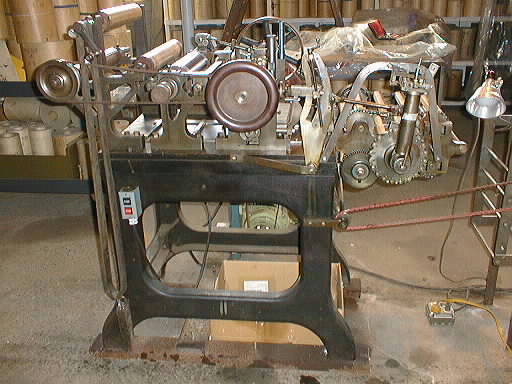
Perforators
no. 11 and 12, their paper
racks and take-up racks, the
master marker, and the paper
slitter are the only pieces
of machinery from that room
whose whereabouts are known
today. These artifacts are
on display, and perforator
no. 11 is in use, at the Herschell
Carrousel Factory Museum ,
North Tonawanda, N.Y., along
with all surviving cardboard
masters used to run the
perforators. Shown below are
perforator no. 11 and its
take-up spool rack.
For an
illustrated description of
the roll-making process, see
HOW
WURLITZER ROLLS ARE MADE
66-KEY
B.A.B. ROLLS 001 TO 044
Using Ozzie
Wurdeman's notebooks,
information from Larry
Villano and George Karpel,
and labels from rolls in
various collections, we have
attempted to reconstruct the
contents of the forty-four
66-key rolls produced by
B.A.B. during its existence.
In addition, one ten-tune
roll was arranged by J.
Lawrence Cook for a group
including Villano and Karpel
in 1971; that too is shown
at the end of this list.
Some of the
listings below may
unwittingly be based on
Wurdeman recuts rather than
on original B.A.B. rolls, as
may be the case with roll
039. It is possible that
Ozzie Wurdeman, lacking the
master for a certain tune
that was supposed to be on
the roll, substituted
another tune in producing
his recuts.
Lack of
tune numbering in a few
cases indicates that the
order of tunes on the roll
is unknown.
Italicized
names (Dominick)
Brugnolotti, (Ambrigio)
Comazzi and (J. Lawrence)
Cook denote the believed
arranger of a roll or
tune, according to Gavin
McDonough and Mikey Mills.
Most
rolls / tunes have been
scanned, edited and
converted to MIDI, with
exceptions noted.
ROLL 001
(1928-32) (not
on MIDI)
(not on MIDI)
(Comazzi)
(Comazzi) (Comazzi) (Comazzi) (Comazzi) (not
on MIDI)
(Comazzi) (Comazzi) ROLL 002
(1932?) (Comazzi)
(Comazzi) (not on MIDI) (Cook) (not on MIDI)
ROLL 003
(1932?) (Unidentified)
(Brugnolotti? Comazzi?)
(Comazzi) (Comazzi)
(From "La Traviata") (Unidentified)
(Inspired by the "Felix The
Cat" animated short films) (Comazzi)
NOTE: Tune 4 likely
misidentified, per Mikey
Mills. ROLL 004
(1932?) (not on
MIDI) ROLL 005
(1932?) (Comazzi)
(not on MIDI)
ROLL 006
(1932?) (From the Fox
motion picture "Merely Mary
Ann") (Comazzi) (not on MIDI) ROLL 007
(1932?) (not on
MIDI) (likely
"Unter Donner und Blitz,"
Op. 234, Johann Strauss, Feb
16, 1868) ROLL 008
(1932, arr
Comazzi) ROLL 009
(1932-1933) (not on
MIDI) ROLL 010
(1932-33 , arr
Brugnolotti) t ROLL 011
(1932-33, arr Comazzi)
(A.B.A. = American
Bandmasters Association) NOTE: Matthew
Caulfield wrote, in an email
to Daniel Robinson, "That
title 'Hail To The National
Flag Lady,' which is what
all B.A.B. sources give and
also appears that way in the
Wurdeman notebooks, has
never checked out. Either it
is a translation of an
Italian title, as a few
B.A.B. tunes are, or, more
likely, a garbled title.
Anyway it doesn't check out
in the Copyright Office
records." George Karpel
suggested the title may
actually be "Our National
Flag Lady." ROLL 012
(1932-1933) (not
on MIDI) ROLL 013
(1933, arr Comazzi)
(possibly "Long Island,"
George Southwell, 1882)
March
(possibilities: Harry Akst,
1929; James F. Stanley,
1930) MarchROLL 014
(1935, arr Comazzi)
(Title song of the Paramount
film)
(Introduced under title "The
Bad In Every Man" in the
1934 Cosmopolitan/MGM motion
picture "Manhattan
Melodrama")
(From the RKO-Radio film "La
Cucaracha")
(From the 1935 MGM motion
picture "The Night Is
Young")
(From the RKO film "The Gay
Divorcee") ROLL 015
(1936)
(Comazzi)
(From "Greenwich Village
Follies Of 1921")
(Comazzi) (not on MIDI)
(Comazzi) (From "A Trip
To Chinatown")
(Introduced in "A Trip To
Chinatown")
(Comazzi)
(likely mislabeled "Genese
Patrol") (Brugnolotti) ROLL 016
(1936)
(Comazzi)
(Comazzi)
(Comazzi)
(not on MIDI)
(Comazzi) (not on MIDI)
(Comazzi)
(From the stage revue
"Provincetown Follies") (not on MIDI)
(Comazzi) (not on MIDI) ROLL 017
(1937) (Comazzi) (Comazzi)
(Brugnolotti)
(From the Republic film
"Rhythm In The Clouds") (Brugnolotti) (Brugnolotti) (Brugnolotti)
(From the 20th Century Fox
film "On The Avenue") (Cook)
(From the Republic film "The
Hit Parade") (Comazzi)
ROLL 018
(1938, arr Brugnolotti
except tunes 3, 6, 8,
Comazzi)
(From the RKO-Walt Disney
film "Snow White And The
Seven Dwarfs") t
(Title song of the MGM film)
(Title song of the 20th
Century Fox film)
(From the 1937 Republic film
"Manhattan Merry-Go-Round") ROLL 019
(1939, arr
Brugnolotti except tune
10, Cook)
(From the film "La route
enchantee")
(From the 1918 Broadway
musical comedy "Oh, Look!") ROLL 020
(1940, arr Brugnolotti
except tunes 4 & 5?)
(From the fifth edition of
"The Royal Palm Revue") (Comazzi)
(Brugnolotti?)
(From the stage revue
"Irene")
(From the RKO film "That's
Right, You're Wrong") ROLL 021
(1941, arr Brugnolotti) (email
editor at carousels dot
org if you know who the
composer is)
(From the 1941 film "Lady Be
Good") Apr 1, 1936) French Waltz
(From the operetta "Lola
Cruz")
(From "Down Argentine Way") (Cook?)
(From the film "Las Vegas
Nights") ROLL 022
(1941) (not on MIDI
except for tunes 1 &
7) (Unidentified)
(Misidentified
as Edwin Franko Goldman's
"Golden Gate")
March (Brugnolotti) (Tune at
soundcloud.com/carouselorgans/bab404-04)
(Please email editor at
carousels dot org if you
know it!) Fox
Trot Fox
Trot (Comazzi) (prob. Karl L.
King/C. L. Barnhouse; source
dates it 1942, but Barnhouse
died 1929) ROLL 023
(1942, arr Brugnolotti)
(From the stage revue "Banjo
Eyes" and 1942 Columbia film
"Sweetheart Of The Fleet") p
(From the 20th Century Fox
film "Week-end In Havana") ROLL 024
(1943, arr Cook)
(From the Universal film
"Give Out Sisters")
(From "In Nutsy Land" and
the Disney film "Der
Fuehrer's Face")
(From the Universal film
"When Johnny Comes Marching
Home") ROLL 025
(1944, arr Cook except
tune 4, Brugnolotti)
(Title song of the Republic
film)
(From the 1944 Columbia film
"Jam Session")
(From the stage revue "A
Romance Of Athlone") (From
the Warner Brothers film "Thank Your
Lucky Stars")
(From "Three Cheers For The
Boys" and the 1944 Columbia
film "Beautiful But Broke")
(From the 20th Century Fox
film "The Gang's All Here") ROLL 026
(1944, arr Comazzi except
tunes 1-2, Cook)
(From the 1932 RKO film "A
Woman Commands") (possibly
"Long Island," George
Southwell, 1892)
MarchROLL 027
(1945, arr Cook)
(From the 1946 MGM film
"Meet Me In St. Louis")
(From the Universal film
"I'll Remember April")
(From the Columbia film
"Carolina Blues") t
(Featured in the 1944
Paramount film "Going My
Way")
(From the Warner Brothers
film "Hollywood Canteen") ROLL 028
(1945, arr Cook)
(From the stage revue "The
Prince Of Tonight")
(From the stage revue
"George Washington, Jr.")
(Adapted from "Andantino in
D-flat" by Edwin H. Lemare) ROLL 029
(1946, arr Cook except
tune 10, Comazzi)
(From the Paramount film
"Stork Club")
(From the 1942 RKO-Walt
Disney cartoon "Saludos
Amigos")
(From the Warner Brothers
film "San Antonio")
(From the 1906 Chicago
musical extravaganza "The
Land Of Nod") ROLL 030
(1947, arr Cook)
(From the 1946 Columbia
motion picture "The Jolson
Story")
(From the RKO-Walt Disney
film "Song Of The South") (From the 1947
musical production "Finian's
Rainbow")
(From the Warner Brothers
film "The Time, The Place
And The Girl")
(Registered as "Good Day,"
Aug 14, 1946) NOTE: Tune 1
was formerly misidentified
here as Dubin &
Franklin's "Anniversary
Waltz" (1941). ROLL 031
(1948, arr Cook)
(not on MIDI) ROLL 032
(1948, arr Cook except
tune 2, Brugnolotti) z
(Based on the German song
"Du Kannst Nicht Treu Sein,"
by Hans Otten, Jan 1, 1935) ROLL 033
(1949, arr Cook)
(Based on the German song
"Du Kannst Nicht Treu Sein,"
by Hans Otten, Jan 1, 1935)
(From the Walt Disney film
"So Dear To My Heart")
(Based on Brahams' Waltz In
A-flat)
(From the stage musical
comedy "Where's Charlie") ROLL 034
(1949, arr Cook) ROLL 035
(1950, arr Cook)
(From the stage revue "Miss
Liberty")
(From the Paramount film
"Shoot The Works")
(From the 1950 RKO-Walt
Disney production
"Cinderella")
(From the stage musical
"South Pacific") ROLL 036
(1951, arr Cook)
(From the stage musical
"Guys And Dolls") z
(Copyrighted as "Dusty Old
Dust (So Long, It's Been
Good To Know Ya)")
(From the MGM film "The
Toast Of New Orleans") ROLL 037
(1951)
(Cook) (Cook)
(Cook)
(Cook) (not on MIDI)
(Comazzi)
(not on MIDI) (Cook)
(Length of a ten-tune
roll) ROLL 038
(1952, arr Cook)
(From the stage musical "The
King And I")
(From the stage musical "The
King And I")
(From the 1944 RKO-Walt
Disney film "Three
Caballeros") (Title song of
the RKO-Radio film) ROLL 039
(1953, arr Cook)
(From the 20th Century Fox
film "Captain January")
(From the Walt Disney film
"Peter Pan")
(From "Hazel Flagg") ROLL 040
(1954, arr Cook)
(From the York Pictures
Corp. film "The Caddy")
(From the stage revue "Earl
Carroll Vanities")
(From the German musical
comedy "Der Schwarze Hecht")
NOTE: Some B.A.B. labels
list tune 3 under its later
title, "Stranger In
Paradise" ROLL 041
(1955, arr Cook) ROLL 042
(1955-56) (Cook) (Comazzi) (Comazzi)
(Cook)
(Comazzi)
(Brugnolotti) (Comazzi) (Cook)
ROLL 043
(1956, arr Cook)
(From the NBC-TV Producer's
Showcase "Our Town") ROLL 044 (1957,
arr Cook) z
(From the Loew's Inc. film
"High Society") (Cook) (Some copies
reportedly have "Singing The
Blues" as tune 5, others
"Ninety-Nine Ways"; Wurdeman
shows the roll both ways)
UNNUMBERED
(1971, arr Cook) (From the 1965 MGM
motion picture "Doctor
Zhivago")
(Title song of the 1966
Everglades/Columbia motion
picture)
(From the 1969 20th Century
Fox film "Butch Cassidy And
the Sundance Kid")
(From the 1964 Walt Disney
musical film "Mary Poppins")
(apparently labeled "Sitting
Downtown In A Railway
Station") The tunes
listed below are some, but
not necessarily all, of the
tunes for which 66-key
masters exist but which
could not be given their
place in one of the 44
B.A.B. 66-key rolls above:
Ah Sweet Mystery
Of Life (Victor
Herbert) (Nov 21,
1910) (Comazzi) (Comazzi) (Comazzi) (Comazzi)
(Cook)
(Comazzi) (Comazzi) (Comazzi)
(Comazzi) (not
on MIDI) (Comazzi)
(Cook) (Comazzi) (Comazzi) (Comazzi)
(Comazzi) (Comazzi) (Comazzi) (Comazzi) (Comazzi) (Comazzi) (Cook) (Comazzi) (Comazzi)
(Cook)
(Comazzi) (Comazzi) (Comazzi) (not on
MIDI)
(Comazzi) (Comazzi)
(Comazzi) (Comazzi) (Comazzi) (Comazzi) (not on
MIDI) (Comazzi)
(Comazzi) (Comazzi) (Comazzi)
(Comazzi) (Comazzi) (Comazzi) (Comazzi) (Comazzi)
(not on MIDI) (not on
MIDI) (not on
MIDI) (Comazzi) (not on
MIDI)
(Comazzi) (Comazzi) (Comazzi) (Comazzi) (Comazzi) (not on
MIDI)
(Comazzi) (not on
MIDI) (Comazzi) unidentified
waltz (Comazzi)
(Note the
preponderance of tunes
from 1929)
The
following 15 tunes are
reported to have also
been put on 66-key
B.A.B. rolls (none are
on MIDI):
Flying
Down To Rio (Title
song of the 1933 RKO
film) (Vincent
Youmans)
(1933)